
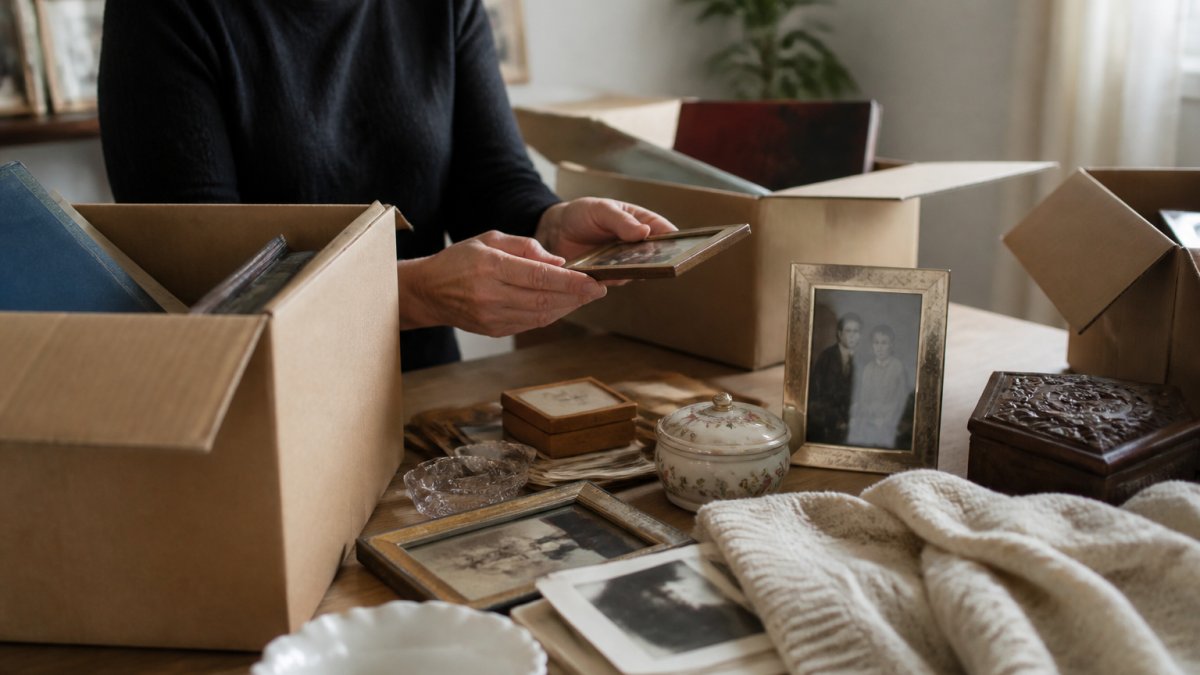
Table of Contents
- Understanding Why Sentimental Estate Items Are Hard to Sort
- Before You Start: Prepare Emotionally and Set Realistic Expectations
- Step 1: Choose Your Time Frame and Work in Short Sessions
- Step 2: Set Up Your Sorting Space and Create Physical Boundaries
- Step 3: How to Declutter Sentimental Items Into Keep, Donate, and Discard Categories
- Step 4: What to Do With Inherited Items and Making the Final Decision
- Preserving Memories: How to Organize Family Photos and How to Store Memorabilia
- Managing Family Input and Resolving Ownership Disputes
- Frequently Asked Questions
Last Updated: October 16, 2026
Understanding Why Sentimental Estate Items Are Hard to Sort
The process to sort sentimental estate items is different from clearing out a garage. When belongings carry memories and family history, each item can trigger grief, nostalgia, or guilt about letting go, which is why many people get stuck.
Sorting sentimental estate items requires patience, compassion, and permission to move at your own pace.
Before You Start: Prepare Emotionally and Set Realistic Expectations
Before you touch a single box, prepare yourself emotionally.
Set realistic expectations.
Give yourself permission to take breaks. Step away when overwhelmed and come back when ready, this isn’t a race.
Consider whether you want support. Some sort with family or a friend, others prefer privacy, and some benefit from a professional’s objective perspective.
Step 1: Choose Your Time Frame and Work in Short Sessions
Decide how much time you have, weeks versus months shapes your strategy.
Break the work into 2-3 hour blocks rather than sorting an entire room in one day.
Create a realistic schedule. With 8 weeks and 40 rooms, plan 2-3 sessions per week.
Write your target date and weekly schedule somewhere visible to stay accountable and keep family informed.
Step 2: Set Up Your Sorting Space and Create Physical Boundaries
Choose a dedicated sorting area with good lighting and room to spread out, a dining table, garage, or basement.
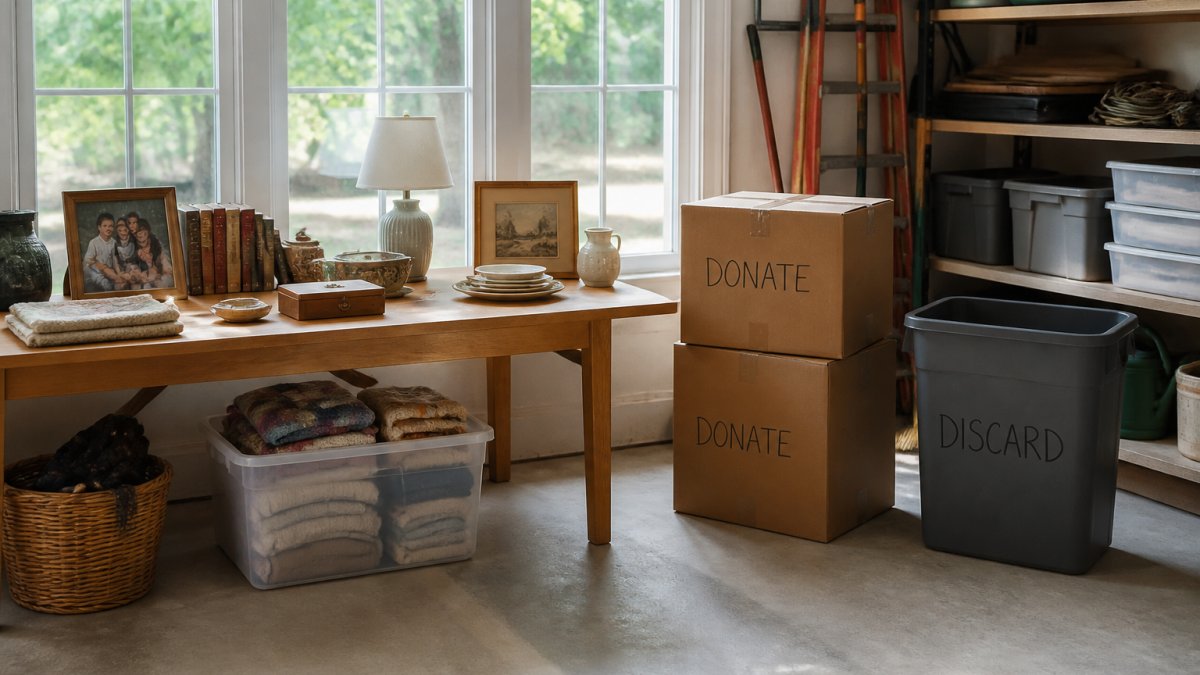
Create physical boundaries for each category using separate boxes, tables, or areas, labeled clearly.
Keep the space calm: avoid clutter, keep tissues nearby, and play soft music if it helps.
Set a “memory box” limit before you start, one box, two, or a shelf.
Step 3: How to Declutter Sentimental Items Into Keep, Donate, and Discard Categories
Most guides tell you to make three piles when you sort sentimental estate items. An estate is different: the costliest mistakes happen when something valuable, hazardous, or legally significant lands in the wrong pile before anyone checks it. Use a four-pile system with a triage pass before anything leaves the house.
The four-pile system
Set up four zones, not three:
- Keep, items with genuine meaning that fit your life now
- Donate, usable items in good condition that someone else can use
- Discard, broken, soiled, or unsafe items
The HOLD pile protects you: nothing goes to donate, discard, or resale until it clears HOLD. One banker’s box is enough, revisit it in 30 days, when the emotional temperature has dropped.
Work the estate in a deliberate sequence
Sorting rooms in random order is how people burn out. Work in this sequence:
- Paper first. Wills, deeds, insurance policies, tax records, certificates, passports, and financial statements are legal, not sentimental. Store them in one labeled file box and keep it with you, not in the donation pile.
- High-value and high-risk items second. Jewelry, watches, artwork, silver, instruments, firearms, tools, and collections go straight to HOLD for valuation.
- Furniture and large goods third. Easiest to photograph, hardest to store, decide them while you still have room to maneuver.
- Clothing, linens, and kitchenware fourth. High volume, low decision cost, fastest to move out.
- Personal papers, letters, and photographs last. The most emotionally loaded material, doing it last means you arrive with practice and a working system rather than raw grief.
The five questions, with estate-specific edits
For each item, ask:
- Does this bring me genuine joy or a specific, nameable memory?
- Do I use or display it, or is it stored and forgotten?
- Would someone else get more use from it than I will?
Add one estate-specific question: Would I recognize this item in a stranger’s house? If no, the memory is doing the work, not the object, a photograph will carry it just as well.
Pause before you release: the valuation checkpoint
This is where families lose money. Before anything goes to donation, recycling, or the curb, run a quick check:
- Look for marks. Maker’s marks, hallmarks, signatures, edition numbers, and country-of-origin stamps signal an item may be worth appraising. Sterling silver is stamped, gold jewelry is hallmarked, and fine china often carries a backstamp.
- Separate categories that routinely surprise people. Costume versus fine jewelry, prints versus originals, reproductions versus period furniture, common books versus first editions, differences often invisible to an untrained eye.
- Flag anything pre-1970 in original condition. Original finishes, boxes, and paperwork multiply value; refinishing or repair can destroy it.
If unsure, the HOLD box is free. A donation is not.
Donate, resell, or recycle
Once an item clears HOLD, match it to a channel:
- Donate to registered charities that issue tax receipts. Ask what they accept first, many won’t take mattresses, large appliances, or damaged furniture.
- Resell through estate sales, consignment shops, online marketplaces, or auction houses. Commissions mean lower-value items may not be worth the effort.
- Recycle or responsibly dispose of electronics, batteries, paint, and bulky items through municipal programs. Most municipalities publish a waste wizard or depot list.
Photograph before you release
Before anything leaves, photograph it on a plain background and name the file with the item and its owner. A photo library takes minutes to build, gives you a permanent record without the storage burden, and settles later questions about what happened to a piece.
Keep a running one-page log of everything that leaves the house: item, destination, date, and receipt. If you are an executor, this log is your protection if a beneficiary later asks where something went.
Step 4: What to Do With Inherited Items and Making the Final Decision
Inherited items carry extra weight because they represent someone else’s life and choices.
Inheriting something doesn’t mean you must keep it forever.
Tell Us About Your Situation →
Ask yourself: would the person who owned this want me to keep it if it made me unhappy?
If you’re struggling with a specific inherited item:
- Acknowledge its history and what it meant to the original owner
- Decide if it fits your life and home now
- If not, sell it, donate it, or pass it to someone who will appreciate it
- Keep a photo if the memory matters
Once you’ve decided something goes, don’t second-guess yourself, commit and move forward.
Preserving Memories: How to Organize Family Photos and How to Store Memorabilia
Preserving memories means keeping what matters and storing it safely so you can enjoy it.
How to Organize Family Photos
Family photos are often the most sentimental items in an estate and deserve proper care.
Sort photos into broad categories, by decade, family member, or event.
Digitize important photos with a scanner or scanning service.
Label photos as you go, dates, names, and context on the back with archival-safe pen, or a spreadsheet.
Store originals in acid-free boxes or albums in a cool, dry place away from sunlight, avoid basements and attics where temperature and humidity fluctuate (Care, Handling and Storage of Photographs).
How to Store Memorabilia Safely
Memorabilia includes letters, documents, awards, certificates, and other keepsakes with personal or historical value.
Use archival-quality materials, regular boxes and plastic bags damage old items, while acid-free boxes, folders, and sleeves protect against deterioration.
Store in a cool, dry place. Moisture and temperature changes damage paper, fabric, and delicate items, avoid basements, attics, and garages.
Managing Family Input and Resolving Ownership Disputes
Estate disputes are usually not about the object, they’re about fairness, grief, and who has authority to decide. Settle the authority question first and most disputes never start.
Establish who has the legal authority to decide
As executor or estate trustee, you have a fiduciary duty to the estate, not to any one beneficiary.
If the will is silent on personal property, the trustee generally has discretion to distribute personal effects, subject to the will and provincial estate law.
A practical safeguard: before distribution, have the executor confirm in writing which items are estate property, which were jointly owned or designated to a beneficiary, and which were already gifted before death.
Run a documented claim process
A written process removes most of the emotion from the mechanics:
- Inventory first. Photograph and list every item above a threshold you set, anything you wouldn’t casually replace. Number each item.
- Circulate the list. Give every beneficiary the same numbered inventory and a fixed claim window, such as 14 or 21 days.
- Collect written claims. Each person submits a ranked list in writing, harder to revise later, easier to compare fairly.
- Resolve overlaps by a stated rule. Rotating picks in birth order, drawing names for order, or priority to the person with the strongest documented connection.
- Record every outcome. A spreadsheet with item number, recipient, and date is enough. Send it to everyone when distribution is complete.
A written inventory plus a written claim window turns a series of arguments into a single, finite process.
When more than one person wants the same thing
State which rule you’re using before claims open:
- Rotating picks. One person chooses, then the next, alternating until the list is exhausted.
- Shared ownership with a schedule. Workable for a cottage, vehicle, or art, but only if someone is responsible for insurance, storage, and maintenance, in writing.
- Monetary equalization. One person takes the item and the value is offset against their estate share, this requires a defensible valuation, not a guess.
Handle the items nobody wants
Set a date after which unclaimed property is donated, sold, or disposed of, and state it in the same notice that opens the claim window. Without a deadline, unclaimed boxes sit in a garage for years and the estate never closes.
When to bring in a neutral third party
Bring in help when any of these appear:
- A beneficiary threatens legal action or stops responding
- The estate includes items of significant or disputed value
- A blended-family or second-marriage dynamic creates sharply different expectations
An appraiser settles value questions, a mediator settles process questions, and a lawyer settles authority questions. Match the professional to the problem rather than hiring one person to do all three.
Protect privacy while you sort
An estate contains more than objects. Financial statements, medical records, correspondence, and digital accounts all pass through your hands. Keep sensitive documents out of shared sorting spaces, don’t circulate photos of private papers to the family group chat, and remember that only the executor and named beneficiaries are entitled to see a will or trust.
Do not distribute, sell, or discard estate property before you have confirmed the executor’s authority and the terms of the will. In most provinces, doing so can expose the executor to personal liability.
Disputes are usually about process, not objects. A numbered inventory, a written claim window, a stated tie-breaking rule, and a documented outcome will resolve more family conflict than any amount of conversation.
Frequently Asked Questions
How do you sort sentimental estate items without feeling overwhelmed?
Work in short sessions of 1-2 hours, focus on one category at a time, and take breaks when emotions run high. Set a realistic time frame, rushing through decades of belongings increases decision fatigue. Create a calm sorting space with clear zones for keep, donate, and discard items. Many people find it helpful to take photographs of items before letting them go, which preserves the memory without requiring storage space. Remember that sorting sentimental belongings is emotional work; pace yourself and ask for support from family or a professional if needed.
What should you do with sentimental items you cannot keep?
Consider multiple options based on the item’s nature and value. Donate meaningful family pieces to relatives who want them, offer items to friends or community members, or explore donation to museums, libraries, or cultural organizations if they have historical significance. For valuable antiques or collectibles, professional appraisal can determine fair market value for resale. Photograph items before parting with them to preserve memories. For items with no monetary or sentimental value to others, responsible disposal through recycling or waste services is appropriate. Donating gives items a second life and can feel more meaningful than discarding.
How do you organize decades of family photos from an estate?
Start by sorting photos into broad groups by decade or family member, then subdivide by year or event if possible. Create a simple filing system using acid-free boxes or archival sleeves to prevent deterioration. Label boxes clearly with dates and descriptions. For valuable or fragile photographs, consider professional digitization services to create backups and make sharing easier with family members. Store originals in a cool, dry place away from direct sunlight. If the collection is very large, prioritize photos showing key family moments or relatives first, then work through the rest systematically. Digital organization allows multiple family members to access and share photos without risk to originals.
What is the best way to store memorabilia safely long-term?
Use archival-quality storage materials: acid-free boxes, tissue paper, and protective sleeves designed for different item types. Store memorabilia in a cool, dry location away from basements (moisture risk) and attics (temperature fluctuations). Avoid plastic bags or newspaper, which can damage items over time. For delicate pieces like medals, jewelry, or documents, consider individual protective wrapping. Keep an inventory list with descriptions and photographs of stored items for insurance and family reference. If space is limited, digitize documents and photographs, then store originals in a climate-controlled location. Label boxes clearly so future generations know what’s inside and why items matter.